



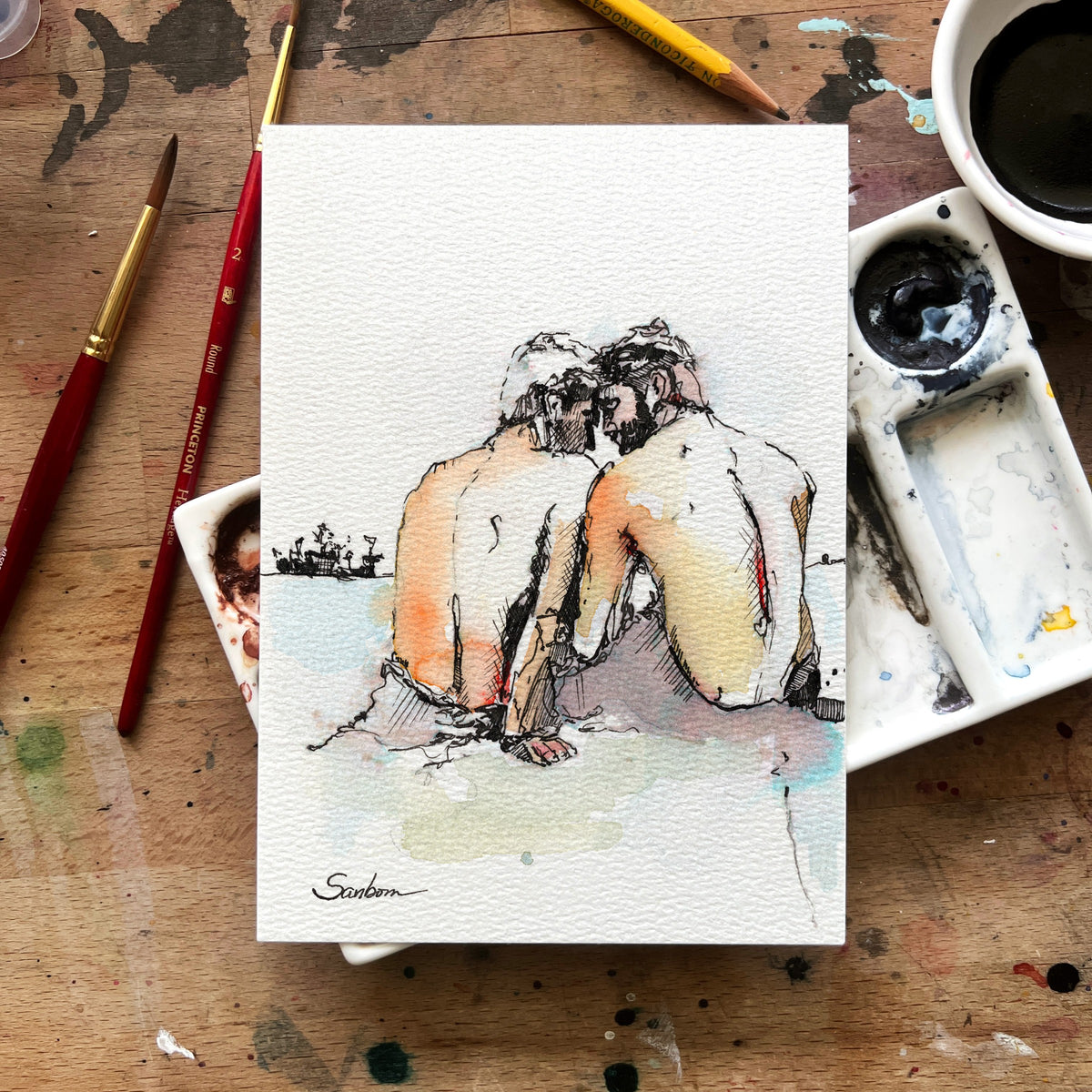

I have been painting the male figure for over two decades. In that time I have made paintings that felt alive the moment they were finished and paintings that felt empty no matter how technically correct they were. The difference between them is not always obvious when you are making them. But it is immediately obvious when you are looking at them.
People ask me what makes a male nude painting powerful. What separates the ones that stop you from the ones you walk past. Here is what I have learned.
It Has Nothing to Do With Technical Skill
This is the thing that surprises people most. Technical skill matters, but it is not what makes a painting powerful. You can paint a anatomically perfect figure with beautiful light and correct proportions and end up with something that feels completely dead. And you can make a loose gestural painting that is technically rough in several places and end up with something that will not leave you alone.
What technical skill does is give you options. It lets you make choices. But the choices themselves, what you include, what you leave out, where you let the paint move and where you stop it, those are what determine whether a painting has power or not.
Presence Is the Thing
The paintings that stop people share one quality above everything else. The figure feels present. Not posed. Not performing. Just there, in the room with you, occupying space and carrying weight.
Presence is hard to manufacture. You can feel immediately when an artist was genuinely looking at something versus when they were executing a formula. Genuine looking produces presence. Formula produces competence.
When I am working on a painting I am asking myself one question above all others. Does this figure feel like it is actually here? Not like a study, not like a demonstration of skill, but like something that was caught in the act of existing. When the answer is yes, the painting tends to work. When the answer is no, no amount of technical refinement will fix it.
The Body as Emotional Document
A powerful male nude painting uses the body to say something that words cannot. Not something literal or narrative, just something felt. The weight in a pair of shoulders. The tension in a hand. The particular angle of a head that suggests thought or grief or desire or stillness without naming any of them directly.
Research in psychology and neuroscience consistently shows that we read bodies before we read faces, and that our response to depicted bodies is visceral and immediate. Psychology Today has covered extensively how humans process figurative imagery emotionally before we process it intellectually. A powerful painting understands this and uses it deliberately.
The body in my work is never just a body. It is a container for something specific that I am trying to put somewhere outside myself. Sometimes I know what that thing is before I start. More often I find out what it was after the painting is finished.
What I Am Actually Looking For
When I am working on a male nude painting the things I am reaching for are:
- a gesture that feels caught rather than constructed
- a quality of light that reveals rather than flatters
- a moment of psychological interiority, the sense that something is being felt
- marks that feel like decisions rather than habits
- enough left unsaid that the viewer has somewhere to go
That last one matters more than people realize. A painting that explains itself completely gives you nothing to do. A painting that withholds something, that leaves a question open, keeps pulling you back. My Drip collection came from learning to leave more unsaid, trusting that what the paint does on its own is often more honest than what I would have planned.

Why Vulnerability Makes a Painting Powerful
The male nude paintings that have lasted, that people return to across centuries, almost always contain vulnerability. Not weakness, but openness. The willingness to be seen without armor.
This is harder to paint than it sounds because vulnerability in a figure is easily tipped into sentimentality on one side or coldness on the other. The paintings that get it right hold both things at once. The figure is open and strong simultaneously. Present without performing.
Paul Cadmus understood this. His figures are unguarded in a way that felt radical in his time and still feels rare now. My post on Paul Cadmus covers why his approach to the male figure still matters.
Why It Matters in a Room
A powerful male nude painting changes the room it is in. Not decoratively, though that matters too, but energetically. It creates a presence that affects how the space feels and how people move through it.
Collectors who own work that genuinely stopped them often describe it as a living thing in their home. Something they have conversations with. Something that looks different depending on what they are carrying when they walk past it. That is not mystical. That is just what happens when a painting has real presence and you live with it over time.
If you want to understand more about what draws people to this kind of work, my post on why collectors are drawn to contemporary male figure art goes deeper into the collecting side of that experience.

What This Means for Collecting
If you are looking to collect work that has genuine power rather than just decorative appeal, trust the piece that makes you stop and feel something you cannot immediately name. That response is not arbitrary. It is your nervous system recognizing presence.
My original paintings are where that search is most direct and most personal. My male figure art prints make that work available at a range of price points without compromising on what matters.
The paintings that have stayed with me longest, both as a maker and as someone who looks at art, are the ones that felt like they knew something. Something specific and true that I could not have gotten any other way.
That is what I am trying to make. Every time.
Share:
How to Care for and Frame Watercolor Art Prints
The Male Figure in Watercolor: Why the Medium Changes Everything