




There are artists who paint the male figure as a subject. And then there are artists who paint it as a confession.
Paul Cadmus was the second kind.
Working primarily in the mid-twentieth century, Cadmus produced a body of male nude art that still feels startlingly alive. Not because of technical brilliance alone, though that was considerable. But because of what he chose to see and what he refused to look away from.

Who Was Paul Cadmus?
Paul Cadmus (1904–1999) was an American painter and draftsman whose work sat at an uncomfortable intersection of classical tradition and deeply personal subject matter. He trained rigorously, drew obsessively, and spent decades quietly building one of the most intimate bodies of figurative work in American art history.
He is perhaps best known publicly for The Fleet's In! (1934), a painting depicting sailors and civilians in a scene of unmistakable sexual energy. The Navy demanded its removal from a government exhibition. The resulting scandal made Cadmus famous overnight, though not entirely on his own terms. The work is now held in the permanent collection of the Smithsonian American Art Museum.
But the work that reveals him most honestly wasn't made for public consumption at all.

The Private Work
His drawings of male nudes — graphite, crayon, silverpoint — were made quietly, often without any intention of showing them. That quality of privacy is precisely what makes them magnetic. There is no performance in them. No awareness of an audience. Just the artist, the material, and the body in front of him.
His subjects included:
- men in private domestic moments
- figures caught mid-gesture or mid-thought
- bodies rendered with sculptural precision but emotional warmth
His figures are sinewy and specific. These are not idealized classical forms. They are people — with particular gestures, particular weights, particular ways of holding themselves. A man pulling on a sock. A figure caught mid-yawn. Someone sleeping with complete unselfconsciousness. Cadmus understood that the most honest male nude art lives in these unguarded moments, not in heroic poses or mythological framings.

What Made His Approach Different
Academic tradition asked artists to elevate the male figure — to make it symbolic, structural, ideal. Cadmus did something more difficult. He made it human.
Every curve of muscle, every tilt of the head carried emotional information. Not necessarily something loud or dramatic. But something you couldn't ignore once you saw it. A slight smirk. The tenderness in a gesture. The quiet between two bodies in the same room.
He also didn't separate the male figure from desire. But he didn't turn desire into spectacle either. His figures aren't performing for the viewer. They're simply present. And that presence — comfortable, undefended, real — is what gives the work its lasting power.
Why It Still Matters
Male nude art has always existed in an uneasy space. Too academic and it becomes a diagram. Too charged and it becomes controversial. Cadmus threaded that needle for seven decades, making work that was neither sanitized nor sensational.
He challenged the idea that male beauty had to be stoic or untouchable. That tenderness and masculinity couldn't share the same frame. That a body could be powerful and still feel fragile. That a private moment could be seen without being violated.
For queer audiences especially, his work carried a significance that went beyond aesthetics. In an era when queer identity had to be coded and carefully managed, Cadmus' drawings felt like proof. Proof that this way of seeing had always existed. That it was serious. That it belonged in the conversation.

A Note From My Own Practice
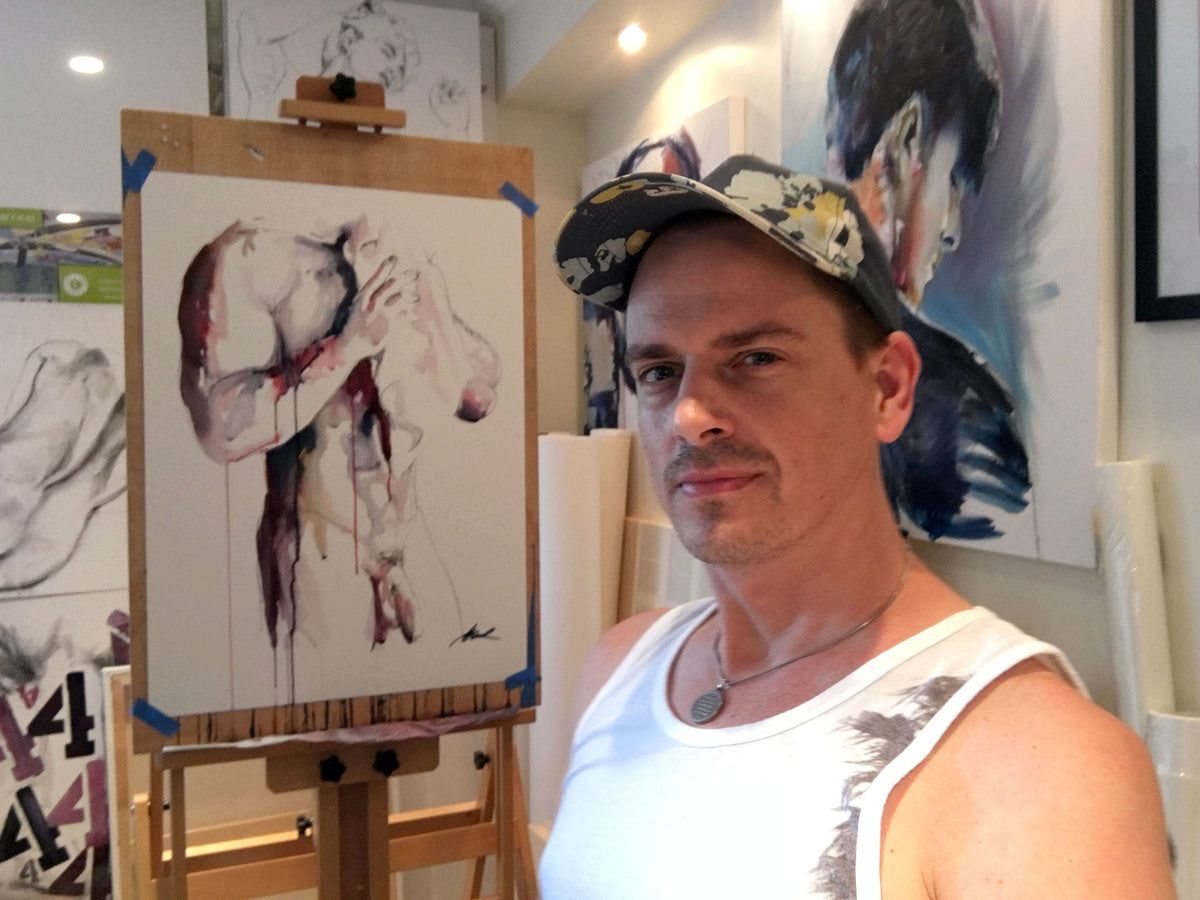
I've spent over two decades painting the male figure and the things that draw me to it are not so different from what drew Cadmus. The private moment. The unguarded gesture. The emotional weight that lives in a simple posture or the turn of a head.
I'm less interested in the heroic male nude than in the quiet one. The figure caught between one thing and the next. That's where the truth tends to live.
If that kind of work resonates with you, you're welcome to explore my male figure art prints and original paintings. And if you want to keep reading about the history of the male nude in art, my post on 12 famous male nude paintings that changed art forever covers some of the broader conversation Cadmus was part of.
Share:
12 Famous Male Nude Paintings That Changed Art Forever
Renaissance Male Nude Art: Pollaiuolo and the Drama of Anatomy